
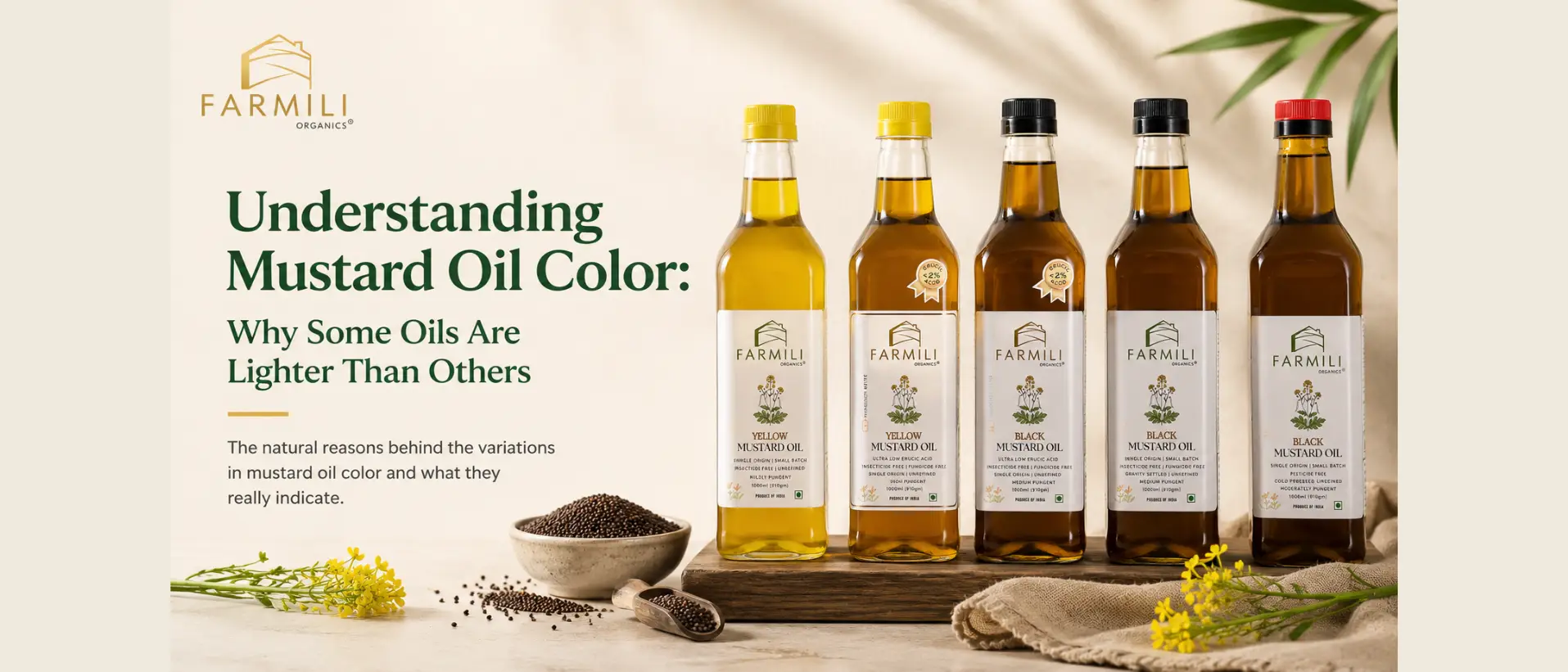
Understanding Mustard Oil Color: Why Some Oils Are Lighter Than Others
Not all mustard oils look the same.
Some appear bright golden yellow. Others are deep amber. Some have a rich brown hue. A few even look almost coppery under certain lighting conditions.
For many consumers, this raises an obvious question:
Which colour is the "right" colour for mustard oil?
The answer may surprise you.
In reality, colour alone tells only part of the story. The shade of a mustard oil can be influenced by several factors, including the mustard variety used, growing conditions, extraction methods, natural settling, and even the stage of harvest.
Understanding these differences helps us appreciate why two authentic mustard oils can look quite different while both remaining perfectly natural.
There Is No Single "Correct" Mustard Oil Colour
One of the biggest misconceptions about mustard oil is that it should always look a certain way.
Some people expect a bright yellow oil.
Others associate quality with a darker, richer colour.
In truth, mustard oil exists on a spectrum.
Natural mustard oils can range from light golden yellow to deep amber and brownish-gold tones depending on how they are produced.
Colour variation is often a reflection of agricultural and processing differences rather than quality alone.
Just as apples, mangoes, or rice varieties can differ in appearance, mustard oils can vary naturally too.
The Story Begins with the Seed
Perhaps the most important factor influencing colour is the mustard seed itself.
Different mustard varieties naturally contain different pigments, oil characteristics, and fatty acid profiles.
This means that oils extracted from different seed varieties may not look identical, even when processed using the same method.
Most consumers rarely think about seed selection when purchasing oil.
Yet the crop itself often determines many of the characteristics people notice in the final product, including colour, aroma, flavour, and pungency.
In many ways, the colour of an oil begins in the field long before extraction takes place.
Growing Conditions Matter Too
Agriculture is influenced by nature.
Soil quality, weather patterns, rainfall, temperature, and growing conditions all affect crop development.
Even when farmers grow the same mustard variety year after year, natural seasonal differences can influence the characteristics of the harvested seed.
This is one reason agricultural products rarely remain identical across every harvest.
Nature does not produce food with factory-like uniformity.
Small variations are part of the story.
Why Cold-Pressed Oils Often Look Different
Processing methods can also influence appearance.
Cold pressing extracts oil mechanically while preserving much of its natural character.
Because the oil undergoes minimal processing, more of its original pigments and naturally occurring compounds remain intact.
As a result, cold-pressed mustard oils often display richer colour variation than heavily refined oils.
This does not mean one is automatically better than the other.
It simply reflects different approaches to oil production.
For consumers seeking foods that remain closer to their agricultural origins, these natural variations are often considered part of the appeal.
The Role of Natural Settling
Freshly pressed mustard oil contains tiny suspended particles from the extraction process.
Over time, many producers allow the oil to settle naturally before filtration and bottling.
This settling process can influence the final appearance of the oil.
An oil that has undergone natural settling may appear slightly different from one that has been subjected to more intensive processing.
Again, colour differences do not necessarily indicate a difference in quality.
They often reflect different production philosophies.
Why Some Mustard Oils Look Darker
Consumers sometimes assume darker mustard oil is stronger or more pungent.
While colour and flavour can occasionally be related, the relationship is not always straightforward.
A darker oil may result from:
- The mustard variety used
- Natural pigments present in the seed
- Harvest conditions
- Extraction characteristics
- Settling and filtration practices
Similarly, a lighter oil does not automatically mean milder flavour or lower quality.
The complete picture involves far more than colour alone.
What Should Consumers Actually Look For?
When evaluating mustard oil, colour should be viewed as one characteristic rather than the deciding factor.
More useful questions include:
- Where was the mustard grown?
- What seed variety was used?
- How was the oil extracted?
- Is the producer transparent about sourcing?
- Are quality standards verified?
These questions reveal much more about an oil than colour by itself.
The most informative details are often the ones consumers cannot see immediately.
Farmili's Perspective
At Farmili, we believe mustard oil should reflect the character of the crop from which it came.
Our mustard oil begins with carefully selected mustard varieties grown on family-managed farmland in Panipat, Haryana.
Because different mustard varieties naturally produce oils with different characteristics, some variation in colour can occur across harvests and batches.
Rather than forcing uniformity through extensive processing, we focus on preserving the natural qualities of the crop while maintaining consistent quality standards.
For us, colour is not something to be engineered.
It is part of the story the seed tells.
Looking Beyond Appearance
Consumers today are more informed than ever before.
They are asking thoughtful questions about ingredients, sourcing, farming practices, and production methods.
That shift is a positive one.
Because the quality of a food product rarely depends on a single visible characteristic.
The next time you compare two bottles of mustard oil, take a moment to look beyond the colour.
Ask where the seed came from.
Ask how it was grown.
Ask how it was produced.
The answers to those questions often reveal far more than the shade of the oil itself.